

Seller Closing Costs in Maryland: What Nigerian Sellers Keep From a $500K Sale
A $500,000 sale sounds great until the settlement sheet starts taking money out. Seller closing costs in Maryland can reduce what actually reaches your bank account.
For a Nigerian family selling in Prince George’s County, that difference may affect the next down payment, moving budget, debt payoff, or cash reserve.
Start With What You Keep, Not the $500K Sale Price
Take a Bowie family selling for $500,000. They still owe $272,000 on the mortgage and expect more than $200,000 in equity.
That is not yet their take-home amount.
Before making plans, I would calculate:
Sale price – mortgage payoff – seller closing costs – buyer credits – other liens = estimated seller net
That last number matters more than the headline price.
What Counts as Seller Closing Costs in Maryland?
The cost of selling a house in Maryland is not one fixed percentage. Some charges come from taxes. Others depend on your contract and property.
A seller may see:
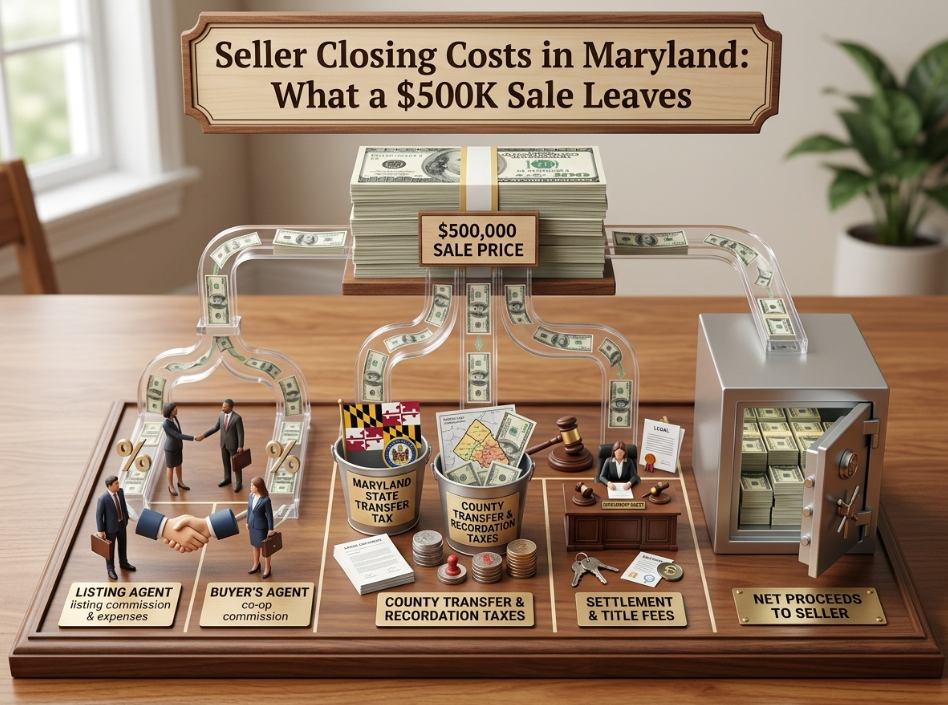
- State transfer tax
- County or local transfer tax
- Recordation tax
- Negotiated broker compensation
- Buyer closing-cost credits
- Property-tax adjustments
- HOA or condo charges
- Lien or payoff fees
- Settlement-related charges
Your mortgage payoff also reduces your proceeds, but I keep it separate from actual closing costs.
That makes the numbers easier to understand.
Who Pays Closing Costs in Maryland?
This is where generic online calculators can give you the wrong picture.
Under Maryland’s tax-sharing rule, transfer and recordation taxes are generally presumed to be split equally unless the contract or another law says otherwise.
That sounds simple until the buyer qualifies as a first-time Maryland home buyer.
Then the tax allocation can change.
A First-Time Maryland Buyer Can Change Your Net
Suppose two buyers each offer $500,000.
One is a regular buyer.
The other qualifies as a first-time Maryland buyer and plans to use the home as a principal residence.
Under Maryland law, the seller pays the state transfer tax in that second situation.
The seller can also be responsible for local transfer and recordation taxes unless the parties expressly agree otherwise for those charges.
So the same $500,000 price can produce a different seller net.
That is a detail worth checking before you compare offers.
How Much Are Seller Closing Costs in Maryland on $500K?
For Prince George’s County, the local transfer tax is 1.4%. The recordation tax is $2.75 for every $500 of consideration.
On a $500,000 sale, the basic tax figures look like this:
| Tax | Total amount |
| Maryland state transfer tax at 0.5% | $2,500 |
| Prince George’s County transfer tax at 1.4% | $7,000 |
| Recordation tax at $2.75 per $500 | $2,750 |
If the usual equal-sharing presumption applies, the seller’s illustrative half is about $6,125.
That is before compensation, buyer credits, HOA charges, tax adjustments, or other property-specific expenses.
Same $500K Price, Different Tax Result
This is the kind of detail I want a seller to see before choosing between offers.
| $500,000 Prince George’s County example | Illustrative seller tax side |
| Normal equal-sharing presumption | About $6,125 |
| Qualifying first-time buyer, no different local-tax agreement | About $11,000 |
The difference is roughly $4,875 in this simplified example.
That does not automatically make the first-time buyer’s offer worse.
Price, financing, contingencies, credits, timing, and closing certainty still matter.
It simply means your seller closing cost estimate should reflect the actual buyer and contract.
What Could a $500K Seller Actually Keep?
Now take a more complete Bowie example.
A Nigerian couple is selling because their family needs another bedroom. They hope to use the equity for their next Maryland home.
| Item | Example amount |
| Contract price | $500,000 |
| Mortgage payoff | $272,000 |
| Illustrative seller tax share | $6,125 |
| Negotiated broker compensation, example only | $12,500 |
| Buyer closing-cost credit | $7,500 |
| Other estimated adjustments and charges | $3,500 |
| Estimated amount remaining | $198,375 |
At first, they thought the sale left $228,000 after the mortgage.
Their working net is closer to $198,000.
That $30,000 difference can change the next-home budget.
Your Mortgage Payoff Is Not a Seller Closing Cost
This distinction matters.
A $272,000 mortgage payoff reduces what you receive, but it is debt you already owed before deciding to sell.
I keep that separate when explaining Maryland closing costs.
Otherwise, a homeowner may think the sale itself costs hundreds of thousands of dollars.
The same logic applies to:
- HELOC balances
- Second mortgages
- Other secured liens
Those reduce your proceeds, but they are not the same thing as transaction costs.
Seller Concessions Can Quietly Change the Deal
Suppose your buyer offers $500,000 but asks for $10,000 toward closing costs.
Another buyer offers $495,000 with no seller credit.
The $500,000 offer is not automatically better.
You still need to compare:
- Buyer financing
- Inspection terms
- Appraisal risk
- Closing timeline
- Contingencies
- Seller net proceeds
A buyer credit should appear as its own line in your estimated seller closing costs.
It should never disappear inside a vague percentage.
If a buyer asks for help, my seller concessions in Maryland guide explains how I compare that request with the rest of the offer.
Broker Compensation Should Not Be Hard-Coded Into a Calculator
Many websites automatically place a fixed commission percentage inside a seller closing cost estimator.
That is not how I would plan your sale.
Broker compensation is negotiated.
Use the amount actually agreed for your transaction rather than copying a national percentage into your estimate.
That gives you a much more useful number.
Small Property Charges Can Still Take Real Money
A single-family home and a condo may not reach closing with the same extra costs.
Depending on the property, you may also see:
- HOA resale documents
- Condo charges
- Unpaid association balances
- Property-tax adjustments
- Water or utility adjustments
- Existing lien payoffs
- Repair credits
- Other contract-specific charges
This is why average closing costs in Maryland should only be an early reference.
Your own property creates the real number.
How I Would Calculate Closing Costs for a Seller
I would build your net twice.
Before listing:
- Estimate the home’s realistic value
- Get the mortgage payoff
- Identify known liens
- Estimate tax allocation
- Add negotiated compensation
- Add known HOA or condo costs
Then create a planning net.
After an offer arrives:
- Replace estimated price with contract price
- Add buyer credits
- Confirm buyer status
- Update tax allocation
- Add inspection concessions
- Use the actual settlement date
That second calculation tells you what the offer may really leave you.
Nigerian Sellers Should Give the Equity a Job
Take the same Bowie family.
They want $150,000 for the next purchase and another $30,000 left untouched as a family reserve.
Their minimum desired net is $180,000.
Now the buyer asks for another $12,000 after inspection.
That request is no longer an abstract negotiation.
The family can ask one clear question:
Does this offer still leave enough money for our next move?
That is much more useful than arguing over every dollar simply because the buyer asked.
If another purchase comes next, my Maryland home buying service can help connect the sale with the next property.
Do Not Raise the Listing Price Just to Cover Closing Costs
Some sellers make this mistake.
They estimate the closing costs in Maryland, dislike the number, and decide to add those costs directly to the asking price.
The market does not work that way.
Your listing price should come from:
- Recent comparable sales
- Current competition
- Property condition
- Updates
- Layout
- Lot and location
- Buyer demand
A buyer or appraiser does not owe you a higher value because your costs are expensive.
My Maryland home selling service starts with what the property can reasonably support in the current market.
Then we work backward to your expected net.
A Closing Cost Estimator Is Only the Starting Point
A closing cost estimator in Maryland can help you get a rough idea before listing.
It cannot see your contract.
It does not know whether your buyer wants $8,000 in closing help, whether your condo has a resale charge, or whether another lien must be cleared.
That is why I prefer a property-specific seller net sheet.
A rough percentage answers, “What might this cost?”
A real net sheet answers, “What might I actually keep?”
Ask for the Seller Net Before You Need to Decide
Do not wait until settlement week to ask how much money is coming back to you.
Before listing, gather:
- Mortgage payoff
- HELOC balance, if any
- Known liens
- Property-tax information
- HOA or condo charges
- Agreed broker compensation
- Realistic local sale range
Then build an early estimate of closing costs for the seller.
When an offer arrives, update it before accepting.
The $500K Price Is Only Half the Story
A $500,000 contract can look impressive.
What matters is the money remaining after the mortgage, seller closing costs in Maryland, negotiated credits, liens, and agreed transaction expenses.
I have worked in DMV real estate for nearly two decades, helping buyers, sellers, landlords, and investors across Prince George’s County and surrounding communities.
You can read more about my Nigerian and DMV background and review client experiences.
If you are selling in Bowie, Upper Marlboro, Hyattsville, Clinton, Lanham, or elsewhere in the DMV, send me the property details.
At The Eze Way, we can start with the number that actually matters:
If your home sells at a realistic price, what are you likely to keep after closing?