

Maryland Tenants’ Bill of Rights: The Lease Check Landlords Need in 2026
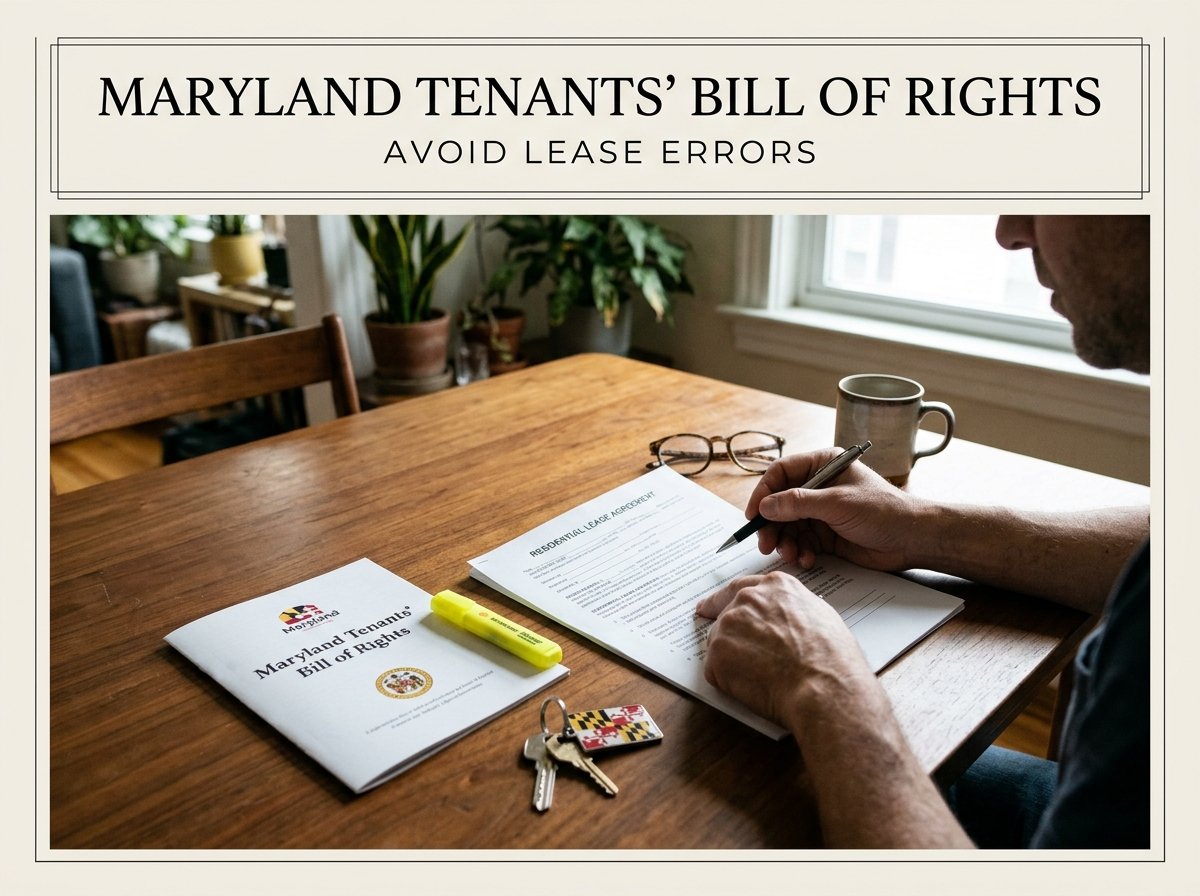
The Maryland Tenants’ Bill of Rights must accompany residential leases. Landlords must attach the current, unedited document published by Maryland’s Department of Housing and Community Development (DHCD). The version effective October 1, 2026, also summarizes important changes affecting screening, rental subsidies, and certain larger properties.
Before signing: Check the attachment, your other disclosures, and local licensing requirements.
A Signed Lease Can Still Have a Missing Attachment
A landlord can spend days choosing a tenant and preparing a lease, then overlook the simplest requirement: including the state’s own rights document.
The state’s tenant bill of rights is not a substitute for your lease. It is a separate state publication that must accompany it. Don’t rely on a link buried in an email.
- Download the latest document directly from Maryland DHCD’s Tenants’ Bill of Rights page.
- Attach the full, unedited version when issuing the lease.
- Keep a dated copy of the signed lease package and proof of delivery.
Why the October 2026 Version Matters
The attachment requirement began July 1, 2025, but using the original release today misses an annual update. DHCD published a new version effective October 1, 2026.
State officials call it the 2027 Tenants’ Bill of Rights; the PDF shows its October 2026 effective date. The official DHCD page is the safest place to check.
- DHCD offers translations, including Urdu, Hindi, Arabic, and French, to help tenants understand the notice. Do not rewrite the state’s official text.
Found an Outdated Attachment? Correct the Record
If you discover a 2025 notice in a 2026 lease folder, don’t backdate your paperwork. Provide the current DHCD document and record the actual delivery date.
- Save the corrected attachment and the message that accompanied it.
- Keep the originally delivered packet for an accurate record.
- Ask a Maryland attorney whether your particular lease needs additional corrective steps.
A clear record is more useful than silently replacing old files.
Small Landlords Are Not Automatically Exempt
Maryland generally requires landlords offering five or more rental units to use written leases. A landlord with fewer units may face additional written-lease requirements under local law.
But when you issue a residential lease, the latest Maryland Tenants’ Bill of Rights must be attached. Owning just one townhouse does not make the attachment irrelevant.
| Rental situation | Practical lease check |
| One Bowie townhouse | Attach current DHCD notice to the written lease |
| Five or more Maryland units | Written lease required under state law |
| A new written renewal | Include the current DHCD version |
| Existing lease without new paperwork | Review renewal terms; don’t assume a fresh lease was signed |
- First-time owner? Review DMV rental-property preparation basics before marketing.
The Lease Still Needs Its Own Legal Terms
The state publication summarizes the legal rights of tenants. It does not fix missing or unenforceable language in your lease agreement.
Under Maryland Real Property Section 8-208, leases must address habitability, utilities, repairs, and the security deposit receipt. They cannot remove statutory tenant protections.
Check your older forms for:
- Late fees above 5% of unpaid rent under the ordinary monthly-rent rule.
- Waivers of legal remedies or improper self-help eviction provisions.
- Automatic renewal language requiring separate acknowledgment, where applicable.
- Unclear responsibility for heat, water, electricity, and repairs.
- Provisions that need an attorney’s review, not edits to the state handout.
New Screening Rules Depend on Portfolio Size
The Maryland Tenants’ Bill of Rights reflects changes effective October 1, 2026, but not every provision applies to every rental owner.
Under the Maryland Fair Chance Housing Act, covered providers managing five or more units and conducting criminal-history screening face new timing, disclosure, and individualized review rules.
- Check when criminal-history information may be requested.
- Understand conditional offers and limited exceptions.
- Give required reasons when withdrawing an offer.
- Do not require applicant drug or alcohol testing.
Voucher Applications Need a Consistent Review
A separate 2026 law protects applicants paying through an income-based housing subsidy. It restricts certain denials based on income, credit score, missing credit history, or qualifying past credit problems.
Landlords may evaluate the tenant’s portion of rent and other lawful, nondiscriminatory criteria. The state’s 2026 landlord-law notice explains these conditions.
Six or More Units? Add a Rent-Reporting Offer
One easily missed 2026 rule highlighted in the Maryland Tenants’ Bill of Rights applies specifically to landlords owning six or more residential rental units in the state.
Those landlords must offer tenants optional reporting of complete, on-time rental payments to a consumer reporting agency. Fees are capped at the lesser of actual service cost or $10 monthly.
| Lease situation | Required timing |
| Signed October 1, 2026 or later | Offer at signing, then at least annually |
| Signed before October 1, 2026 | Offer by January 1, 2027, then annually |
| Tenant accepts | Report as elected; observe fee limits |
Don’t Treat an Old Lease Renewal as a New Contract
A newly signed written renewal should include the current rights document. An automatic continuation without a new lease is a different situation, governed by the existing contract and law.
Track renewal dates alongside the state’s October updates. If you aren’t sure whether paperwork constitutes a new lease, have a Maryland landlord-tenant attorney review it.
- Log when the renewed lease was sent and accepted.
- Check annual updates before issuing the next written agreement.
- If selling while occupied, review Maryland rental-sale notice considerations separately.
Cooling Rules Apply to Certain Apartment Buildings
The updated Maryland tenants’ rights publication also describes a cooling law for qualifying units in apartment buildings with 10 or more residences, not every rented single-family house.
Covered units need air conditioning capable of reaching 80°F or lower from June 1 through September 30. Eligibility depends on building age, equipment history, lease terms, or qualifying renovations.
- Before planning upgrades, confirm your building and unit are covered, rather than treating an apartment rule as universal.
Prince George’s County Licensing Depends on the Address
For Prince George’s County owners, the state attachment is only one piece. Rental licensing may fall under the county or a municipality.
A Bowie rental and an unincorporated Upper Marlboro rental can have different licensing authorities. Hyattsville, Greenbelt, and College Park also appear on the county’s municipal exception list.
- Consult the county rental-license instructions.
- Confirm the municipality through SDAT records.
- Check local inspections, rent-stabilization rules, and required disclosures separately.
- Include compliance costs when assessing rental property ROI.
Build One Lease Packet You Can Reuse Carefully
A clear lease package helps both sides understand their obligations and provides useful records if questions arise later. Reuse the process, not an outdated attachment. For electronic signing, verify the tenant receives every page.
| Before signing | Save in your property file |
| State rights attachment | Current version and delivery record |
| Lease and disclosures | Executed agreement and acknowledgments |
| Screening decisions | Consistent policy and required notices |
| Rent-reporting offer, if covered | Written offer and tenant election |
| Licensing and inspections | Current property-specific records |
Prepare the Rental Before Advertising It
I’m Eze Okwodu, a Maryland Realtor with nearly 20 years of real estate and investing experience in Prince George’s County and the greater DMV. My Zillow profile shows a 5.0 rating from 60 reviews.
Through The Eze Way, I help landlords evaluate rental pricing, competition, property readiness, and long-term investment decisions. Legal compliance determinations belong with qualified attorneys and authorities.
For your rental’s next move:
- Compare local rental prices before choosing an asking rent.
- Test rental cash-flow assumptions rather than relying on gross rent.
- Explore my landlord rental services or contact me about your property with the address, expected rent, and preparation questions.